Typing on a Mechanical Typewriter in the Year of Our Lord 2025
Typing on a Mechanical Typewriter in the Year of Our Lord 2025
I want the font color to be Blue. I currently have a purple ribbon loaded, so that needs to come out. The gloves I wear are wet purple, making it look like I tried to strangle a grape monster with my bare hands after I've wound the stuff in the machine onto the reel.
But First, I Need to Change the Ribbon
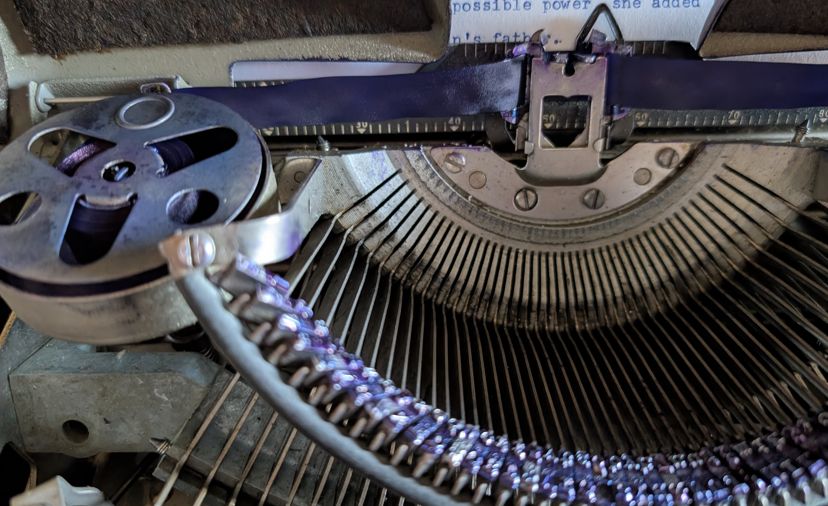
Once all the ribbon has been extracted out, I do my best to wipe the machine down. No matter how much I try to only touch the ribbon and reel, I still can't avoid touching the outside of the machine and purple marks show where I messed up. Soap can get most of it out if I'm quick enough. The Remington Quiet Riter I use doesn't even technically ribbon reels, instead using built-in reels that need to be manually spooled.
The machine is 20 pounds, and older than my Baby Boomer parents by a small margin. It's built like a tank and only "portable" because it comes with a case that it can lock into. Like a tank, it is prone to mechanical mishaps: dust, lubricant, and rust are the true killers in our midst. The rust is what I try to avoid by immediately attempting to dry the machine off as soon as I humanly can.
Ok. The Purple ribbon is out. Putting ribbon in is not really like taking it out, at least on this machine. I have to cut the ends so that the punched-in buttons are the correct length line up with the auto-ribbon-reverse lever in the inside of the reel, and then I got to wind it all the way back in.
That's... fine, but I have to adapt the ribbon to fit in the first place. A knot has been tied to approximate the metal buttons would be on this new ribbon, and I have to cut some of the length way down in order to fit my particular typewriter.
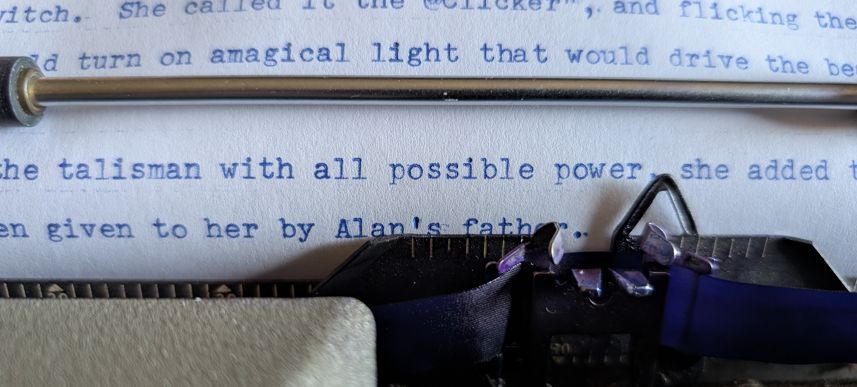
Once I got it wound in, I have to align the middle length of the ribbon with the typewriter "vibrator", you know, the bit of metal near the paper that shoots up into view to intercept the character so that an imprint is actually made. This is different for each machine but for mine I have to pinch these little levers together in order to get the ribbon into a particular zone.
Only now is the procedure complete, when I unclip the levers back into place on the vibrator. My machine has a little quirk where I need to work the vibrator back into motion, but it is easy enough. Just need to type some with no regards to what is on the page.
And only now is the procedure to change the font color complete. If I want to make it a clean getaway, I should also wipe down the letter-heads of each key, but I don't care at that level. This isn't getting sent to anyone important.
The Physical Act of Typing
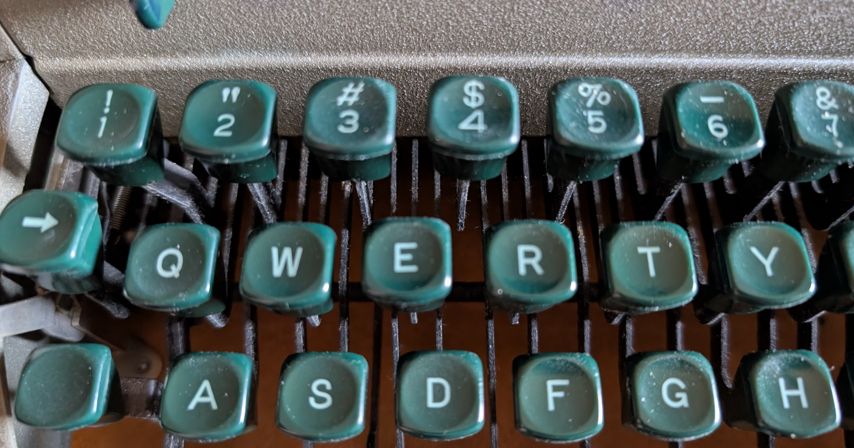 There is a thing you learn very quickly when using a true blue mechanical typewriter; that is; you can't type too fast. If you attempt two characters at once, the type heads crash, and you have to stop your flow to reach up and knock the head back down. Now, ordinarily, this is a bad thing. They even made a type of typewriter that was specifically made to avoid this: the electronic typewriter. The moment memory was cheap enough to allow the typewriter to keep track of a couple characters at a time, we shoved it into the things so we could buffer a few characters while an electric motor tapped out the characters safely as soon as it could (which, to be clear, is still fast).
There is something to be said about needing to force your key presses into a very specific order. In my case, at least, it transforms the act of typing into something more like playing a piano. It puts you into a certain rhythm or flow state, and this applies some momentum to the act of writing itself. It's a little hard to explain; I kind of get going and then I blink and there is a page full of text and it is thirty minutes in the future.
On a personal note, there is a phenomena I noticed in my on typing output where the text itself would get cleaner as it went. Part of that is that my typing technique got better. My touch typing got a bit more sure, true, but the comparison I made about playing an instrument is more apt than I realized.
You see, you don't want to press a typewriter key all that hard. If you are having trouble making a mark, then what probably needs to happen is that the ribbon needs to be changed. Normal operation actually is looking for quick taps of the keys, and the momentum brings them up to the ribbon to make the mark. Ideally, this should be as light as possible, the paper should not be embossed. My typewriter also had the effect of seeing letters double up if I pressed to hard, probably because the type-head bounced.
I actually got the hang of the correct pressure and cadence too, eventually, but it was a road to get there. There was a breaking-in phase where I had to figure out what was wrong, and fixing it. The Remington I was using had renovated somewhat, but it was not purged of all its old lubricant. The places with old lubricant needed to either be cleaned or worked through. The major quirk I had to contend with was adjusting the throw and spacing of the typehead and the plantain. There are three screws you have to play with, and then, if you mess with those settings, you also then have to mess with the vertical alignment of the caps and lowercase letters. And you do that with, you guessed it, more screws.
On top of that, the rail that the carriage slides on had some gummy lubrication. This manifested as some characters randomly stacking on top of each other, which isn't great for readability or staying in a flow state. Fixing this took a bit of doing, mostly because tracking it down was extremely vague. At first I thought that something was wrong with the escapement, which is the gear within most typewriters that allows the carriage to move only one character per key-press at a time. Fortunately it was not that, because the escapement is pretty integral to the machine and as such is really tricky to get at or remove. Nothing a bit of mineral spirits and a applicator needle can't fix, but you still need those in order to fix it, and I don't want to keep mineral spirits in my apartment. Honestly I'm unsure what ultimately fixed my particular issue, since I wound up cleaning so many parts around the carriage and escapement.
Artists are Shaped by their Tools
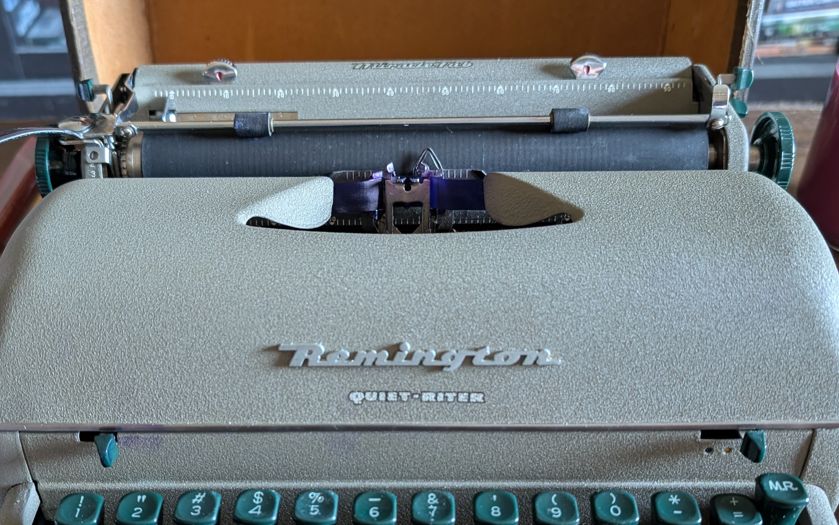
I am no stranger to the labor and craft of making marks for writing. I was previously (and I guess currently) into fountain pens and weird pencils. To refill those is an undertaking and a risk to my clothes, to use them is to risk turning your hands black. But, unless the paper is bad, I rarely regret doing so. I feel an analogous way to what I type on paper with the typewriter, albeit faster.
I think that is the other thing that I get out of the typewriter: once you get used to it, you can go mad fast. And boy howdy, does everyone in your room and the room over know that you are on a roll. It sounds a little like operating a machine-gun, and I have one of the quiet ones. Once I got better with how the keypresses are supposed to actually go, it got quieter, but it also got more consistent. Belt-fed words in the war of discourse.
I think the biggest thing I get out of the exercise is the view of progress. To have a stack of papers that I can look upon and behold is the nicest thing about all of this. I have a weird mental short-circuit where I don't really register all that I've done creatively. I'll make a bunch of stuff but when the time comes for the year review I don't remember any of it. I've written small books before but it never feels like I have because at the end of the day it is just a file that sits in Dropbox until I need it. But having a binder full of my work, that feels nice. That is something I vaguely knew I needed, but I didn't know how badly I needed it.
My dad had this saying when we were riding bikes together that his biking improved his running and vice-versa. I think the typewriter typing is helping me type elsewhere. The actual typing technique, and its regimentation that is required for a typewriter, back feeds into what I do on the computer. It also helps that digital typing is physically much, much easier. I bet this is how secretaries felt about electric typewriters when they first came out. I also bet that helped save their hands due to the reduced force, but that is neither here nor there.
A harder thing to quantify about writing changes I've noticed about myself is the new mindset I have found. I am typing this on a FreeWrite, a nifty device that I love but I have an incredibly hard time recommending because of how fucking expensive it is ($700!!!), which is doubly ironic because a lot of people will almost pay you to take an old real typewriter off of their hands. I have noticed that my relationship with this thing is much different now than when I first got it. I used to think of it as a word pad, and it is that, but I would think way too hard about what I was putting down when really I should have been focusing recording it at all. I am writing this purely by touch; I do not look at the E-Ink screen at all because I don't have to. It's just free-association; and I can clean it up later when I have access to an actual word processor that has much better editing capability. This thing does not even have spellcheck.
And that is kind of by design, right? When I do this on the Remington, I am watching what comes out because it is instant and also I have concerns like line width and monitoring the ink and impression that happens on the page. These thoughts happen in a parallel place in my mind that run simultaneously with the story or higher level thoughts I'm trying to capture. Would this work if I was writing something more intricate? Only time would tell, but I bet I could capture the critical path if it so came to that.
This clearly would not work if I was writing, say, a mystery. But I bet it would spit out some authentic character interactions within that mystery that could then be refined in a second pass; and you know what, that is most of the battle most of the time.
With the typewriter I am banging out a sort of slice of life/journal thing. It is mildly sci-fi, but I am more interested in what the characters think about the terrible situation that they have found themselves in. It also helps that the characters themselves are using typewriters to record their thoughts (for various contrived reasons), so it comes out as a sort of performance art through writing, or method writing maybe? I think that is a more apt comparison than I'd like. For a few hours at a time, I pretend to be the character writing down their hopes and dreams on the page, trying to filter what I know about their world with what they know right then and their perspective. The other trick to this is that they are not rational beings, but emotional ones. They have done things that don't make a ton of sense but now it is everyone's problem, and that is where the story lies. Because the logic of their emotions makes complete sense, but it is also putting everyone in danger. But they also never had another choice.
The method acting expands to other things. Do they have white out? Do the overtype their mistakes or XXXX them out? Maybe they hyphen it out instead? Maybe they are a trained typist and they retype pages instead. There is a lot of character in what they type, how they type it, and how they approach the physical object that they ultimately produce.
I want to write more in 2026. I think it is imperative to get better at it, because I think that is the skill that will set me apart from the me of the past, AI, employers, and those that want to erode the human experience. Time will tell if that is something people will value, but I think that it is something I need to resolve to value. Like how I learned to like type-writers. Or certain kinds of movies, or challenging art, or horror games. These things are skills in their own right, and it is a challenge to not always spring for the easy, digestable media/thoughts/paths that we could be taking instead.
I just hope I'm not alone in that mindset.